● Methodology
Write the process down. Let agents run it. Improve it every week.
Most teams bolt agents onto a process built for people, then wonder why review piles up. We start from yours: how work is chosen, built, checked and approved. We write it down, run it with agents and measure every change to it.
01 Principle
Start from how you work
What comes in, who builds it, how it is checked, who approves it and what “done” means. We write your current process down as a workflow, stage by stage, with its checks and its decision points.
Each step gets its own instructions, its own environment and its own limits. Ready workflows are a starting point, not a template you have to adopt.
02 Principle
Keep your tools
Your tracker, your repository provider, your CI and its required checks, your Storybook, your single sign-on. Assign an issue in your tracker the way you would to a teammate. It moves through your own statuses and closes when the change is merged.
All integrations →- Linear
- Jira
- GitHub Issues
- Azure DevOps
- Beads
- GitHub
- Bitbucket
- GitLab
- Azure DevOps
- GitHub Actions
- Pipelines
- GitLab CI
- Claude Code
- Codex
- OpenCode
- Pi
- Docker
- E2B
- Kubernetes
- AWS
03 Principle
Put people where judgement matters
Each workflow says where a person decides: approving a design, accepting a change, raising a budget. Before anyone is asked, the checks and the agent reviews have already run. Every request arrives with:
- why the work stopped;
- the evidence: runs, checks and reviews;
- what each answer will do to the work;
- the factory’s recommendation, when it has one.
Review rounds are capped, so nothing loops forever.
Reviews & decisions →04 Principle
Earn autonomy, one workflow at a time
Start with a person approving every merge. When a workflow’s numbers show it is safe, switch that workflow to merge on its own and leave the rest as they are.
Budgets and limits cap what any single task can spend or retry, whatever its level.
05 Principle
Change the process like code
Every change to a workflow or to a project’s rules is a new version with a note. A change to the rules is previewed against the last seven days of work before it goes live.
Work in flight stays on the version it started with, and the previous version is one step away.
06 Principle
Measure, then improve
Changes to the process are marked on the charts, so you can see whether they helped. Rules raise a flag when a number drifts, and agents file the problems they find along the way instead of fixing them silently.
Insights →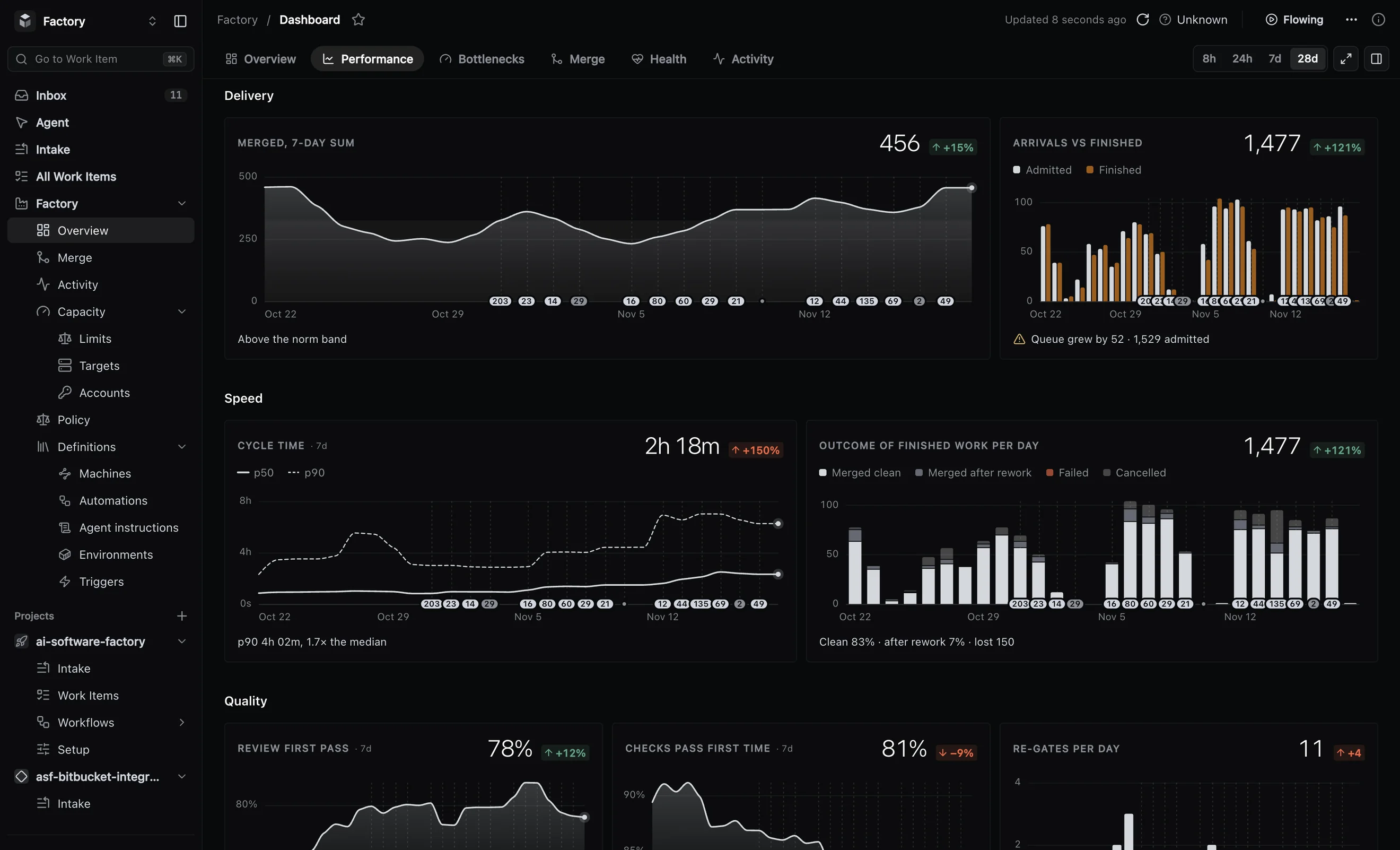
- Changes merged per week
- Cycle time, p50 and p90
- Review passed first time
- Checks passed first time
- Cost per merged change
- Decisions asked of people
- Main branch green
- Where work waits
● How we work
A methodology that already runs a factory
We run our own product this way: 1,753 changes in six weeks, 87% of them with no person stepping in. We bring the same working parts to your team.
How we work →A definition of ready
Agents start only on work that is clear enough to do. An incomplete brief is refused before the work starts.
A definition of done
Checks enforce it before anything merges: the tests, the reviews and the documents that must change with the code.
Review rules
Reviewers block on a short, agreed list. Everything else becomes follow-up work instead of another round.
Decision rules
What agents decide, what people decide, and how that line moves as a workflow proves itself.
Roles for agents
Planner, implementer and reviewer, each with its own instructions, so no agent does everything from one long prompt.
A weekly review
Of the numbers and of the process itself: what to change next, and whether last week’s change helped.